CE motorcycle armour levels: EN 1621-1 and EN 1621-2, level 1 vs level 2
How CE impact protectors are tested and rated, what level 1 and level 2 mean in kilonewtons, and how to choose and pocket armour for private-label jackets, jeans and hoodies.
By Hamza Gosha, Director Sales & R&D · Updated 12 October 2026
In short
CE motorcycle armour is tested by dropping a weight onto the protector and measuring the force that passes through. Limb protectors follow EN 1621-1: level 1 must keep the average transmitted force below 35 kN, level 2 below 20 kN. Back protectors follow EN 1621-2: level 1 averages 18 kN or less and level 2 averages 9 kN or less. Lower force means better protection. Blackthorn World builds riding garments with pockets sized for CE EN 1621-1 and EN 1621-2 armour.
- Limb armour
- EN 1621-1 (shoulder, elbow, hip, knee)
- Back armour
- EN 1621-2
- Chest / airbag
- EN 1621-3 / EN 1621-4
- Level 1
- Limbs under 35 kN average; back 18 kN or less
- Level 2
- Limbs under 20 kN average; back 9 kN or less
- Garments
- Armoured hoodies, textile jackets, jeans
How armour is tested
A protector is placed over an anvil shaped like a body part and struck with a falling weight carrying 50 joules of energy. A sensor under the anvil records the force that reaches it. The lower the force, the more energy the armour absorbed. Each sample is struck several times, including after conditioning hot and cold.
Level 1 vs level 2
| Standard | Body area | Level 1 | Level 2 |
|---|---|---|---|
| EN 1621-1 | Shoulder, elbow, hip, knee and tibia | Average under 35 kN; no single strike over 50 kN | Average under 20 kN |
| EN 1621-2 | Back (spine) | Average 18 kN or less; no strike over 24 kN | Average 9 kN or less; no strike over 12 kN |
Level 2 armour roughly halves the force reaching the body, but it is usually thicker and heavier. Level 1 is lighter and bends more easily, which suits casual gear such as hoodies and jeans. Many brands fit level 2 at the back and level 1 at the limbs.
Markings to look for
- Standard and level, for example "EN 1621-1:2012 Level 2".
- Zone code: S (shoulder), E (elbow), H (hip), K (knee) or K+L (knee and lower leg).
- Size type: A or B for limb protectors; FB (full back) or CB (central back) with torso length for back protectors.
- Temperature marks T+ or T−, if tested hot or cold.
Choosing armour for a private-label range
| Garment | Typical armour | Why |
|---|---|---|
| Armoured hoodies and riding shirts | Level 1 limbs, optional level 1 or 2 back | Thin and flexible for casual wear |
| Riding jeans | Level 1 or 2 knee, level 1 hip | Height-adjustable knee pockets help fit |
| Textile and adventure jackets | Level 2 shoulders and elbows, level 2 back | Higher protection for touring |
| Race suits | Level 2 throughout | Track and sport use |
What to specify
- Pocket size and position for each protector, including adjustable knee height for jeans and pants.
- Whether armour is supplied with the garment or fitted by your brand.
- The protector level for each zone and the size type (A or B; FB or CB).
- How the armour is labelled so the marking stays visible.
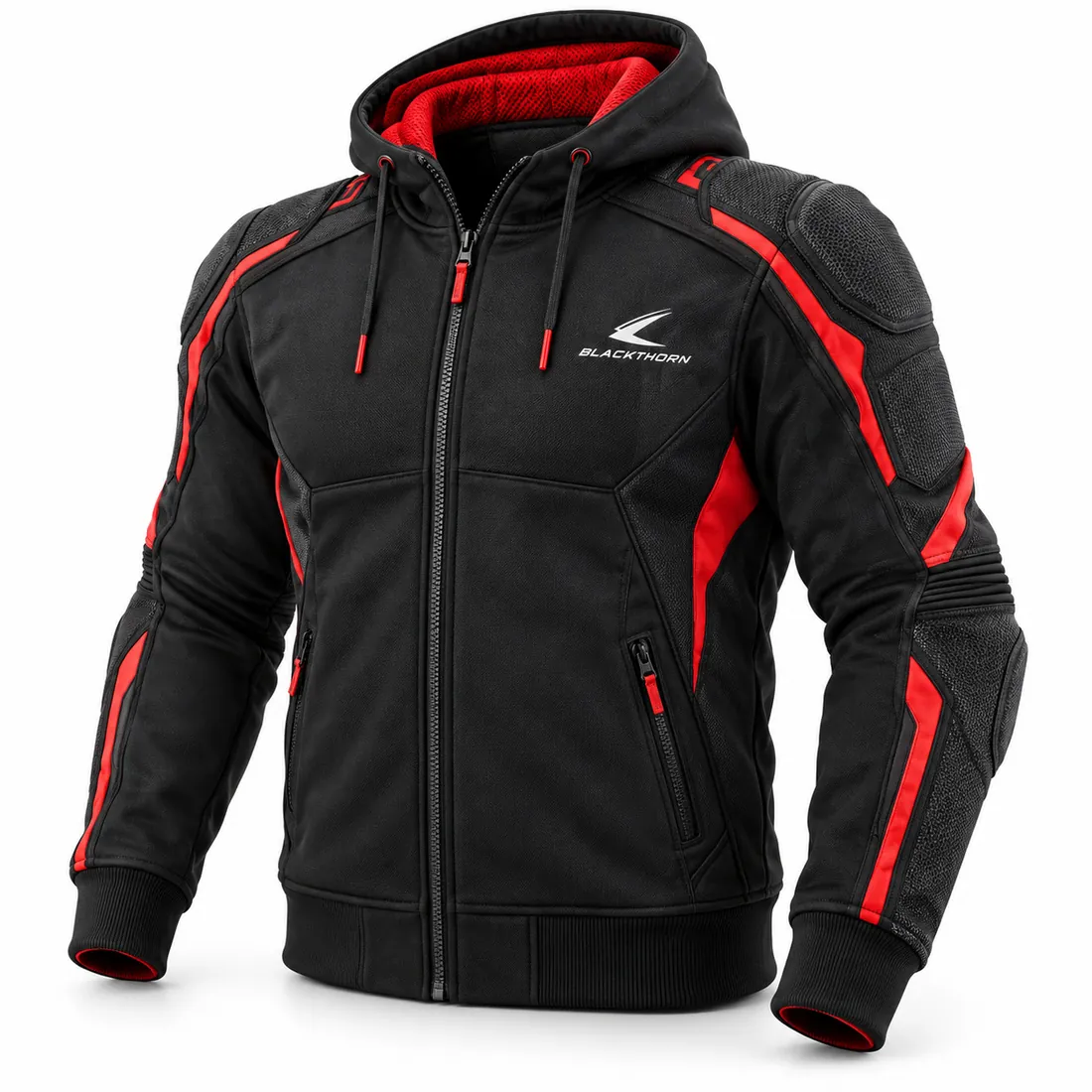
Blackthorn World builds jackets, pants, jeans and hoodies with pockets sized for CE EN 1621-1 and EN 1621-2 protectors. For the garment rating itself, see our EN 17092 guide.
Related guides and pages
Frequently asked questions
What does CE level 2 armour mean?
Level 2 armour lets through less force in the drop test: an average under 20 kN for limb protectors and 9 kN or less for back protectors, compared with 35 kN and 18 kN for level 1.
Is level 2 armour always better?
It protects more but is thicker and heavier. Level 1 is often chosen for hoodies and jeans where comfort and a slim look matter.
What is the difference between EN 1621-1 and EN 1621-2?
EN 1621-1 covers limb protectors for shoulders, elbows, hips and knees. EN 1621-2 covers back protectors.
Does armour make a jacket EN 17092 certified?
No. EN 17092 rates the whole garment, including abrasion and seams. Armour is one part of it.
Can Blackthorn World supply armour with garments?
Our garments carry pockets sized for CE armour; protectors can be supplied or fitted by your brand, as specified on your order.