Sourcing custom varsity jackets: eight builds, what they really cost, and what a 10-piece minimum changes
Most varsity factories start at 50 or 100 pieces. We start at 10. This guide explains the eight ways a varsity jacket can be built, what each one costs on an indicative FOB basis, which decoration method suits which shell, and how to brief a factory so your first sample is close enough to approve.
Published 1 November 2026 · Blackthorn World
In short
A custom varsity jacket is a shell, a sleeve, a trim and a decoration method, and each choice moves the price. Blackthorn World manufactures eight builds — wool melton with cowhide sleeves, full vegan leather, brushed cotton fleece, satin, MA-1 nylon flight bomber, all-over sublimated print, printed-lining wool and knitted varsity cardigans — from 10 pieces per style, with indicative FOB prices from about $18 to $78 per piece and door-to-door delivery to the USA, Canada, the UK, Ireland, Europe, the Nordics, Japan, Australia and New Zealand.
Start with the shell, not the logo
Buyers almost always open a conversation with artwork. Factories need the shell first, because the shell decides the price band, the decoration options and the lead time — and the artwork has to be adapted to whichever one you pick.
There are eight constructions worth knowing. Everything else is a variation on these.
| Build | What it is | Indicative FOB | Best for |
|---|---|---|---|
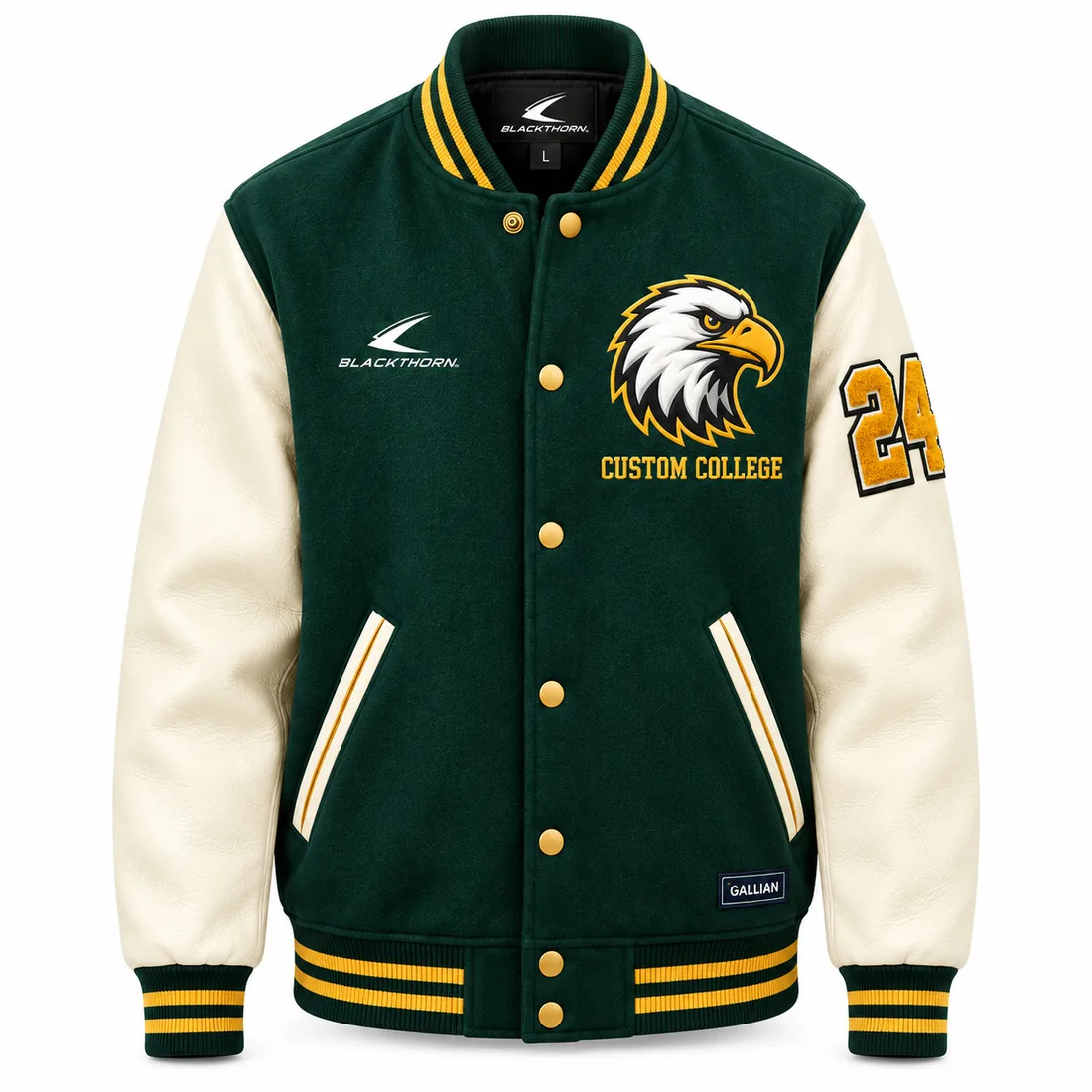
| Wool melton + cowhide sleeves | 24 oz melton body, full-grain leather sleeves | $41–$78 | Schools, alumni stores, premium brands |
| Full vegan leather | 0.8 mm PU on body and sleeves | $29–$56 | Vegan ranges, sharper retail margins |
| Brushed cotton fleece | 380 gsm fleece, no leather, home washable | $18–$36 | School leavers, clubs, budget programmes |
| Satin | 120 gsm lustre satin, quilted lining | $19–$38 | Tour merch, events, crew gifting |
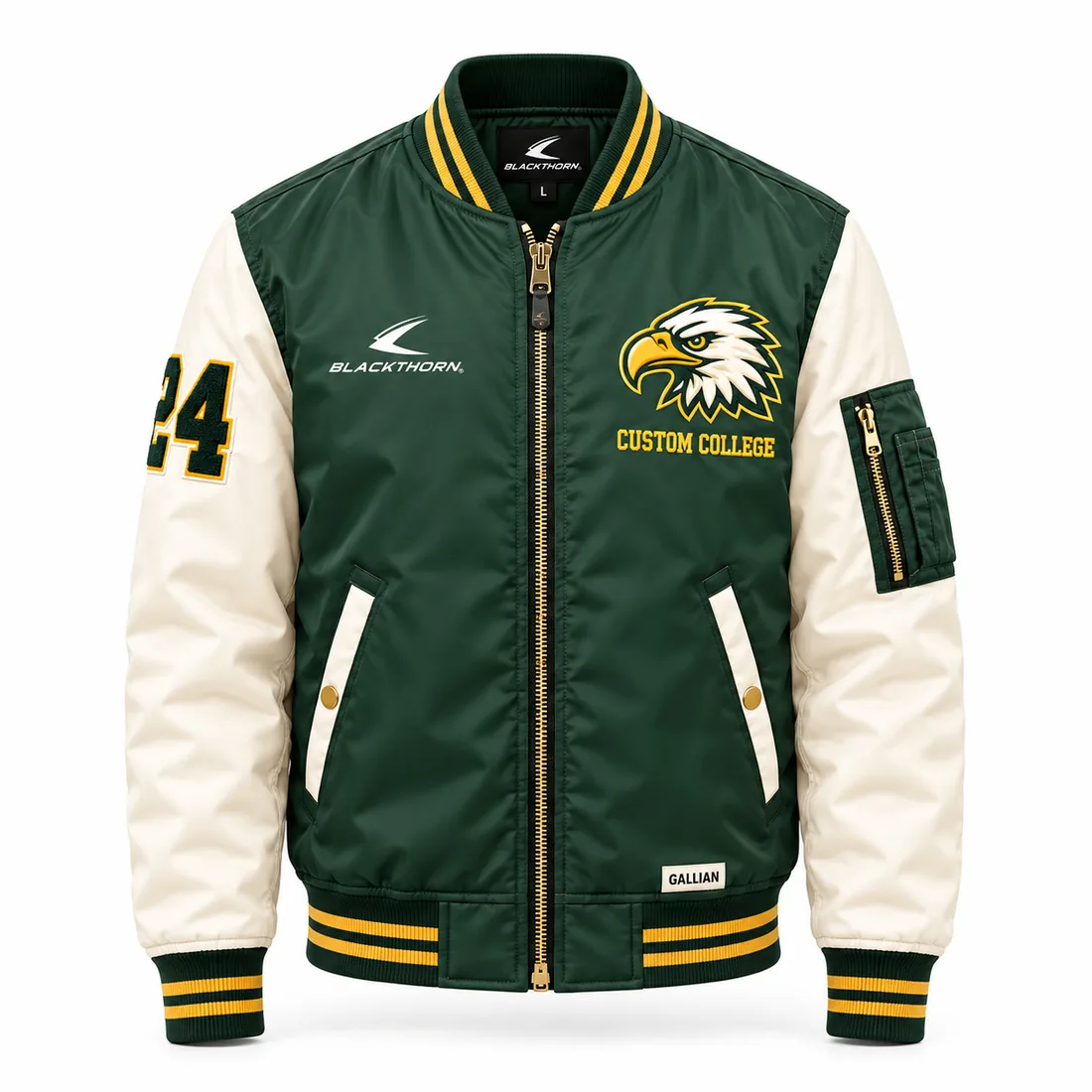
| MA-1 flight bomber | DWR nylon shell, 120 gsm wadding, sleeve pocket | $24–$46 | Wet markets, touchline and travel wear |
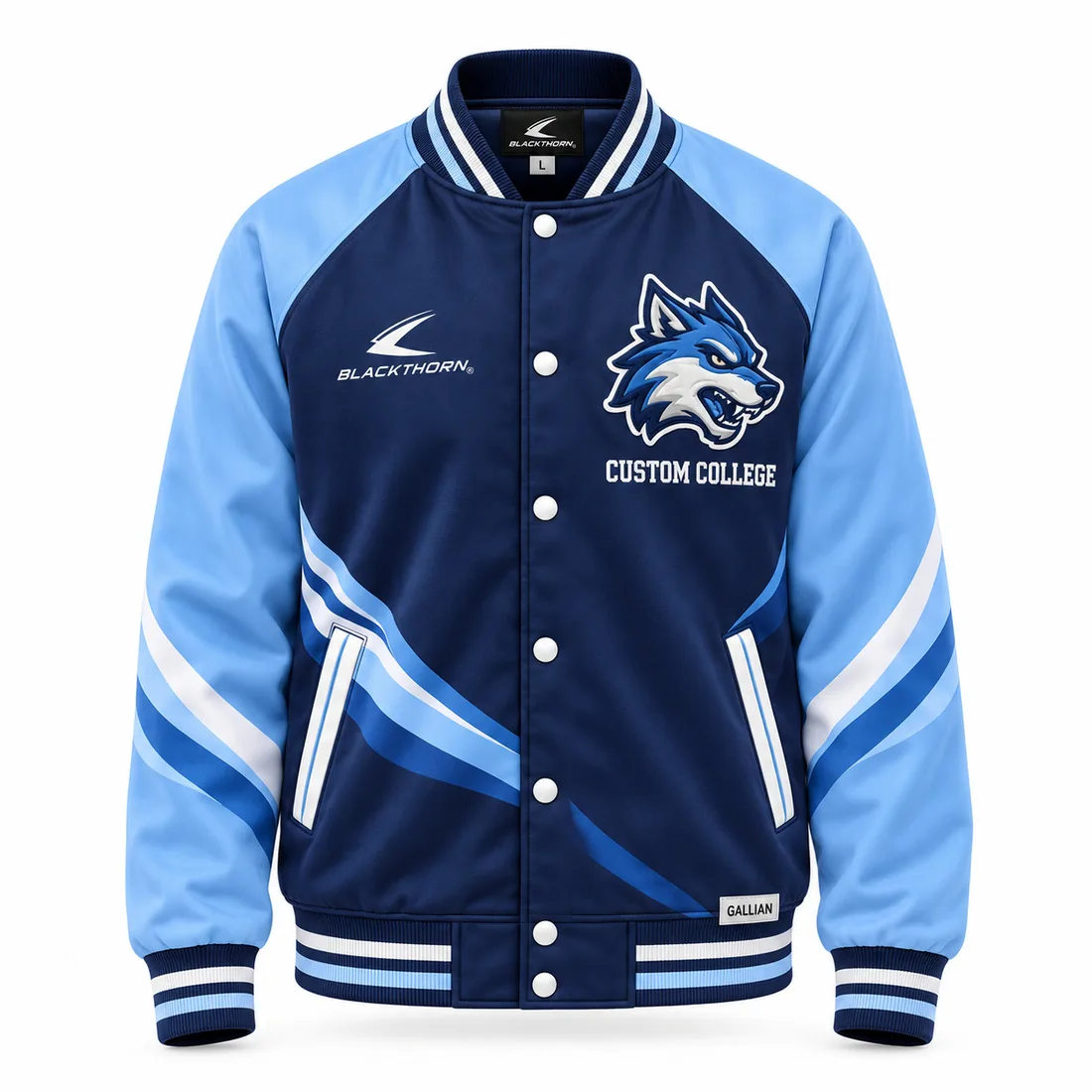
| All-over sublimated | 240 gsm polyester, printed before cutting | $20–$41 | Teams needing per-player names, complex artwork |
| Printed-lining wool | Traditional melton shell, custom printed interior | $30–$58 | Limited editions, keepsakes, anniversaries |
| Knitted varsity cardigan | 12 gauge knit, striped rib, intarsia numbers | $25–$48 | Award and prefect programmes, fashion ranges |
Prices are indicative FOB per piece and move with quantity, decoration and trims. The low end of each range is a four-figure run; the high end is a 10-piece order.
What a 10-piece minimum actually changes
A 50-piece minimum sounds reasonable until you work out what it costs to be wrong. Fifty jackets in one colourway, in one size curve, in a style nobody has yet bought, is a four-figure bet placed before a single customer has seen the garment.
At 10 pieces per style the arithmetic changes in three specific ways:
- You can test instead of forecast. Put ten jackets into one store or one drop, see the sell-through, then reorder the winner at volume. The pattern is already developed, so the second order costs nothing extra in development.
- You can run more colourways. Thirty jackets as three colourways of ten tells you far more than thirty of one. For a brand building a range, that is the difference between a line sheet based on data and one based on taste.
- Small institutional orders become possible. A graduating cohort of twelve, a first team squad, a company anniversary for fifteen staff — all of these fall under most factories' minimums and simply do not get made.
The trade-off is honest and worth stating: per-piece cost at 10 is materially higher than at 1,000, because the cutting, marker-making, dye lots and machine set-up are the same whether you make ten or a thousand. You are paying for flexibility. Our tier pricing shows exactly where that gap closes, so you can see the point at which a larger commitment pays for itself.
Decoration: match the method to the shell
Decoration is where most first orders go wrong, because the method that looks best in a reference photo is not always the method that survives on the fabric you picked.
- Chenille — the raised, fuzzy texture of a classic varsity letter, on a felt backing. It needs a dense, stable ground: melton, heavy fleece or knit. It is the premium option and it reads as one.
- Tackle twill — cut fabric letters stitched down with a satin edge. Crisp, durable, cheaper than chenille, and it layers well for two- and three-colour emblems.
- Flat and 3D embroidery — the right choice for small logos, fine text, years and outlines. Puff (3D) embroidery works beautifully on fleece and badly on satin.
- Dye sublimation — polyester only. Unlimited colours, gradients and photographic panels at no extra cost, and a different name and number on every jacket for the same price as a plain one. It will not bond to wool, cotton or leather.
- Heat-sealed and silicone badges — the practical answer on PU leather and coated nylon, where needle penetration is a weak point.
Two rules save most of the trouble. Do not specify sublimation on a wool or leather shell; it physically cannot work. And do not put heavy chenille on a lightweight satin without a backing panel, or the shell will pucker within a season.
What actually drives the price
In rough order of impact on a varsity jacket quotation:
- Sleeve material. Full-grain cowhide against PU is usually the single biggest line on the costing — often a third of the difference between two otherwise identical jackets.
- Body fabric weight. 24 oz melton against 380 gsm fleece is a large gap in both material cost and sewing time.
- Quantity. The step from 10 to 200 pieces typically takes 25 to 30 percent out of the unit price, because set-up is amortised across more garments.
- Decoration count and complexity. A chest crest, a back script, sleeve numbers and an inside name panel is four operations, not one.
- Lining. A plain quilted satin against a fully sublimated custom print is a few dollars a piece — the cheapest perceived-value upgrade on the whole garment.
- Trims. YKK against generic zips, antique brass against plated snaps, woven against printed labels. Individually small, collectively visible.
Ask any factory to break these out as separate lines rather than quoting one number. If they will not, you cannot tell which lever to pull when the price comes back above your target.
Sizing, labels and private label
Two details separate a jacket that gets reordered from one that gets refunded.
Grading. A 4XL should be a properly graded block, not a stretched large — the armhole, the sleeve head and the body length all move independently. A women's fit should be a different block, not a smaller man's jacket. Ask to see the grade rules; a factory that cannot produce them is scaling one pattern up and down, and the large sizes will fit badly.
Labelling. For private label work you need a woven neck label, a care and composition label correct for your destination market, a hangtag and a polybag. Note that private neck labels, care labels and swing tags carry a 500-piece minimum of their own because of the weaving and printing set-up, so they are produced with bulk rather than with samples. On a 10-piece first order we will use a neutral label and switch to yours at volume.
Beyond that, OEM, white label and private label all mean the same thing in practice here: nothing of ours appears on the garment, the carton or the paperwork, and distributors can have cartons shipped straight to their own customer.
Lead times and getting the goods to your door
Plan backwards from the date you need stock on a shelf, not forwards from the day you send artwork.
- Free 3D mock-up: 1 to 3 working days from receiving artwork.
- Development sample: 7 to 14 days, charged per style and credited against your first bulk order. Knitted cardigans take 10 to 14.
- Bulk production: 3 to 4 weeks for satin and fleece, 4 to 5 for flight bombers and sublimated styles, 4 to 6 for wool and leather builds.
- Air freight: 3 to 6 days door to door for the USA, Canada, the UK, Ireland, Europe, the Nordics, Japan, Australia and New Zealand.
- Sea freight: 25 to 40 days port to port, worth it above roughly 500 pieces.
A realistic first order from artwork to delivered goods is nine to twelve weeks. Anyone promising four has either skipped the sample or is decorating blanks — which is a legitimate business, but it is not the same product.
How to brief a factory so the first sample is close
Send these seven things in one message and you will usually skip an entire round of revisions:
- Which build you want from the eight above — or a reference photo and let the factory tell you which it is.
- Artwork as vector (AI, EPS or PDF) or a layered PSD at 300 dpi full size. A phone photo of a sketch is enough to start; our design team redraws it.
- Pantone references for body, sleeves and each rib stripe.
- Decoration method and placement for each position — chest, back, sleeves, inside.
- Size breakdown, and whether you need unisex, women's or youth blocks.
- Quantity per style and per colourway.
- Destination country and whether you want FOB or a landed, duty-paid price.
Send it to sales@blackthorn-textile.com or WhatsApp +92 334 096 2222. You will get fabric options, a tiered costing and a sample plan back within one working day.
FAQ
What is the minimum order for custom varsity jackets?
Ten pieces per style at Blackthorn World, with sizes and colourways mixed freely. Most varsity factories start at 50 or 100 pieces, so a 10-piece minimum is what makes retail testing, single-cohort school orders and small team runs possible.
How much does a custom varsity jacket cost?
Indicative FOB prices run from about $18 per piece for brushed cotton fleece at volume to about $78 for wool melton with full-grain cowhide sleeves at the 10-piece minimum. Sleeve material, body fabric weight, quantity and decoration count are the four biggest drivers.
Which varsity jacket build should I choose?
Wool melton with cowhide sleeves for schools and premium brands; full vegan leather for the same look without hide; brushed cotton fleece for the lowest cost and home washing; satin for events and speed; MA-1 flight bomber for wet climates; sublimated for per-player names and complex artwork; printed-lining wool for limited editions; knitted cardigans for award programmes.
Can every jacket have a different name and number?
Yes. On sublimated jackets it costs nothing extra because each panel is printed individually from your roster spreadsheet. On wool, leather, fleece and satin builds, chenille, tackle twill or embroidered names are charged per piece.
How long does it take from artwork to delivered goods?
Nine to twelve weeks is realistic: 1 to 3 days for a 3D mock-up, 7 to 14 days for a development sample, 3 to 6 weeks for bulk depending on build, and 3 to 6 days of air freight door to door.
Do you ship varsity jackets door to door?
Yes — to the USA, Canada, the UK, Ireland, Europe, the Nordics, Japan, Australia and New Zealand through DHL, UPS and FedEx, with sea freight for container volumes. We can quote FOB or landed with duties included.