Private label work and safety shoes: S1P vs S3, toe caps and soles explained for distributors
Safety footwear is a repeat-purchase product with clear standards, which makes it attractive for workwear distributors and PPE brands. Here is what to specify for a private-label range.
Published 27 October 2026 · Blackthorn World
In short
Private-label work shoes are specified by safety class under EN ISO 20345 (SB, S1, S1P, S3 and newer S1PS/S3S codes) or ASTM F2413 in the US, toe cap (steel or composite), midsole penetration protection, outsole (PU, PU/TPU or rubber) and upper. Blackthorn World develops them through qualified footwear partners under its own QC from 100 pairs per style, with samples in 15–20 working days.
What do S1P and S3 mean?
Under the European standard EN ISO 20345, every safety shoe has a 200-joule toe cap. The class codes add further protection:
| Code | Adds | Typical use |
|---|---|---|
| SB | Toe cap only | Basic safety |
| S1 | Closed heel, antistatic, energy-absorbing heel, fuel-oil resistance | Indoor, dry: warehouses, factories |
| S1P | S1 + penetration-resistant midsole | Logistics, light construction |
| S3 | S1P + water-resistant upper and cleated outsole | Outdoor construction, wet sites |
The 2022 revision of the standard added codes such as S1PS and S3S for non-metallic penetration inserts, and a slip-resistance marking. In the US, ASTM F2413 covers impact and compression toe protection, with optional electrical-hazard and puncture ratings. Your target market decides which standard you certify to.
Steel or composite toe cap?
- Steel — thinnest and cheapest for the same protection; heavier and conducts cold.
- Composite — lighter, metal-free (good for airports and security screening), does not conduct cold; slightly bulkier toe.
Which sole?
- PU — light and cushioned; most common on S1P trainers and shoes.
- Dual-density PU/TPU — cushioned midsole with a harder-wearing outsole.
- Rubber — best grip, heat resistance and durability for construction, oil and gas, and hot surfaces.
Shoe, trainer or boot?
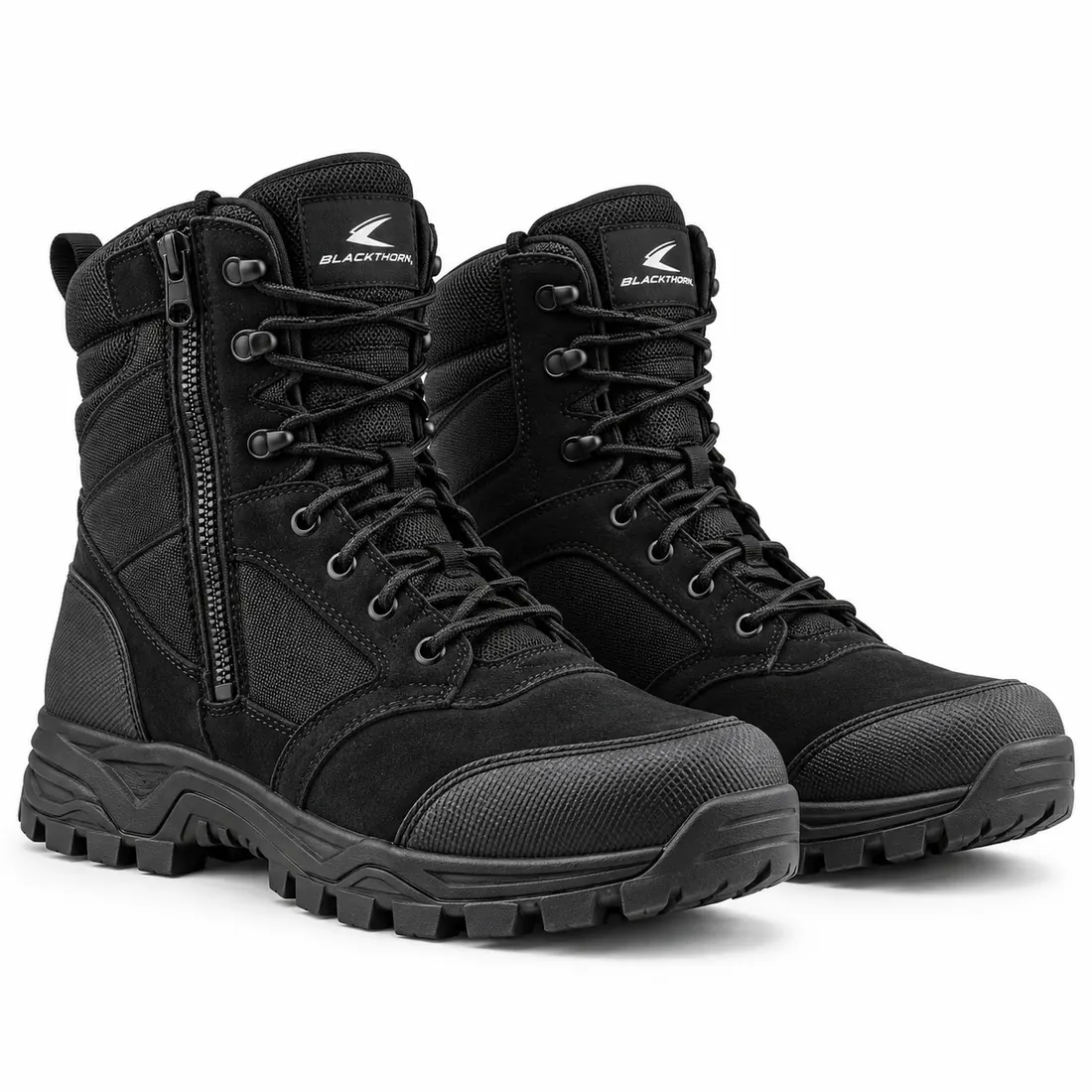
Distributors usually build a range of four: a safety trainer (S1P) for logistics, a low shoe (S1P/S3), an ankle boot (S3) for construction, and a dealer or Chelsea boot. Adding a side-zip duty boot, like our black duty boots, covers security and patrol buyers.
Certification, MOQ and price
Safety footwear has to be type-tested per model at a notified body (for CE and UKCA) or an accredited lab (for ASTM). We develop models through qualified partner factories in Pakistan and arrange testing; certification cost and time are quoted with the development plan. The minimum is 100 pairs per style, with sizes mixed. Samples take 15–20 working days; bulk 2–3 weeks after approval. Indicative FOB prices for work boots and shoes are in the same $26–$55 band as our duty and hunting boots, depending on toe cap, midsole and sole compound.
See our footwear manufacturer page, the boots range, and match footwear with workwear and impact work gloves from the same supplier.
FAQ
What is the difference between S1P and S3 safety shoes?
S1P adds a penetration-resistant midsole to S1; S3 adds a water-resistant upper and cleated outsole on top of that, for outdoor and wet sites.
Steel or composite toe caps?
Steel is thinner and cheaper; composite is lighter, metal-free and does not conduct cold.
Are your safety shoes certified?
Each model must be type-tested; we arrange EN ISO 20345 or ASTM F2413 testing and quote it with development.
What is the MOQ for private-label safety shoes?
100 pairs per style, with sizes mixed.
How long do samples take?
15–20 working days; bulk follows 2–3 weeks after approval.
Also in other languages: العربية